
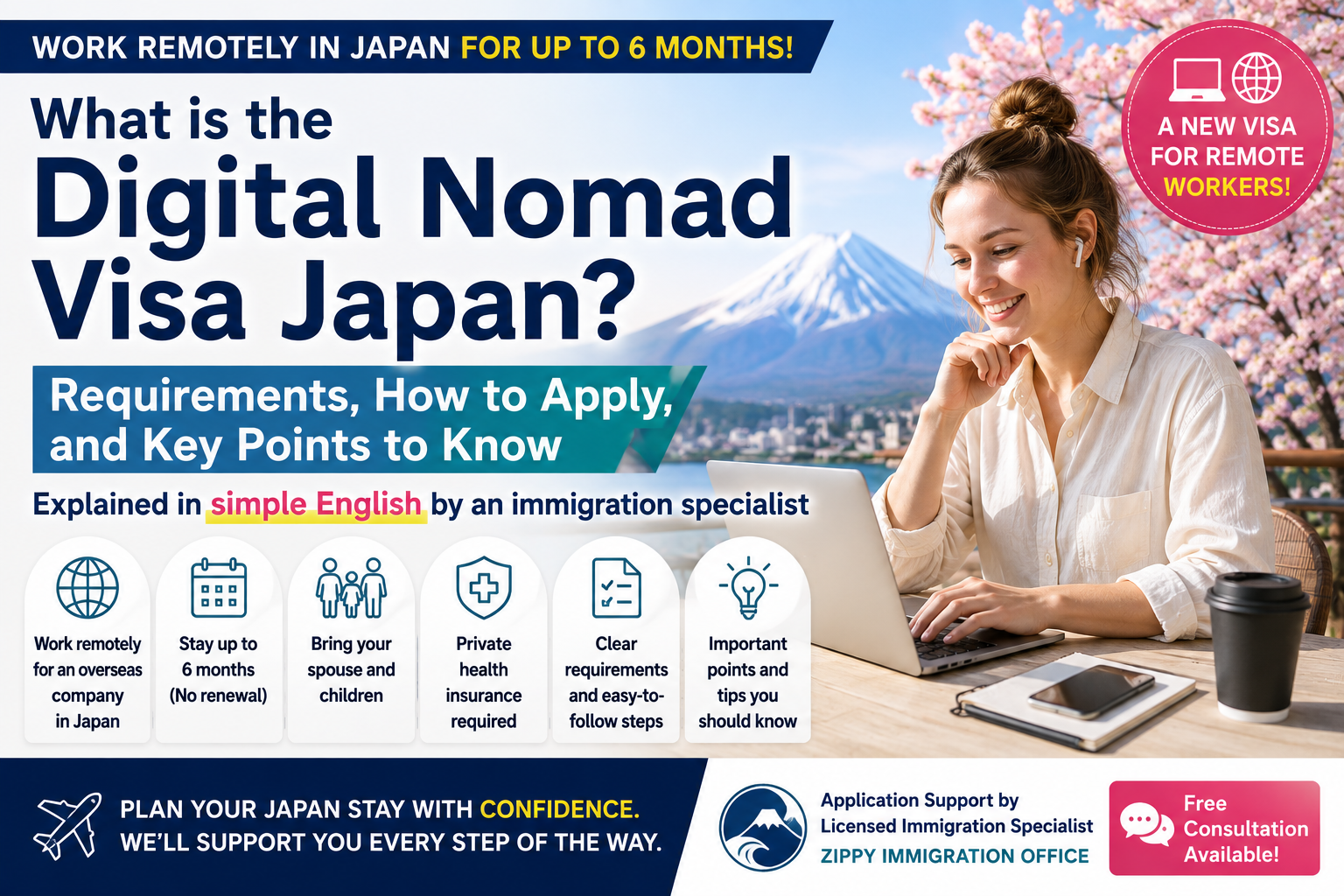
Japan Digital Nomad Visa: Requirements, Application & Pitfalls (2026 Guide)
Want to spend six months working remotely from Japan — legally, with your family, without visa-run gymnastics?
Since March 2024, Japan has offered a Digital Nomad Visa (officially, the “Specified Activities” residence status, Designation No. 53).
It is still surprisingly under-used, mostly because reliable English information is scarce.
This guide covers who qualifies, how to apply, and the pitfalls nobody tells you about — written by a Gyoseishoshi (Certified Administrative Procedures Legal Specialist) and certified immigration application agent based in Saitama, just north of Tokyo.
What the visa actually is
Japan’s Digital Nomad Visa lets you live in Japan for up to six months while working remotely for an employer or clients outside Japan.
Your spouse and children can join you under a companion status (Designation No. 54).
The key concept: this is not a visa to work in Japan — it is a visa to do your foreign work from Japan.
You cannot be hired by a Japanese company or invoice Japanese clients on this status.
The six requirements
| Requirement | Details |
| 1. Nationality | You must hold a passport from one of 49 eligible countries/regions — visa-waiver countries that also have a tax treaty with Japan (US, UK, Germany, France, Australia, Singapore, South Korea, Taiwan and others; as of Feb 2026) |
| 2. Income | Annual income of JPY 10 million or more (roughly USD 65,000–70,000, exchange-rate dependent). This is your individual income; for freelancers it is judged on profit after expenses, not gross revenue |
| 3. Work | Remote work for a foreign employer, or freelance work for clients outside Japan |
| 4. Length of stay | Up to six months within any one-year period. No extension — but you can re-apply and return the following year |
| 5. Health insurance | Private insurance covering death, injury and illness with at least JPY 10 million (approx. USD 65,000) in medical treatment coverage for your entire stay |
| 6. Family | Spouse and children come under Designation No. 54 and need the same level of insurance |
The income test trips people up most often. It is per-person, not household. If both partners each clear JPY 10 million, each can apply as a principal.
Digital Nomad Visa vs. the 90-day tourist stay
・Time: six months instead of 90 days — long enough to see cherry blossoms and autumn leaves on a single stay.
・Legality: remote work during a tourist stay has always been a grey zone. The nomad visa makes your foreign remote work explicitly permitted.
・Family: your spouse and kids get proper long-stay status instead of stacking tourist entries.
How to apply — two routes
・Route 1: Apply at a Japanese embassy or consulate in your country before you travel.
・Route 2: Enter Japan as a tourist first, then file at a regional Immigration Services Bureau inside Japan.
Route 2 is popular for a simple reason: you can test-drive Japan for a few weeks and convert without flying home.
It is also the route where a licensed immigration specialist in Japan can handle the filing for you.
Core documents: application forms, passport, proof of income (employment contract, tax statements, client invoices), a description of your remote work, and your insurance certificate showing the coverage amount.
In our experience, how you document income and insurance is what decides both the outcome and the processing speed — especially for freelancers with multiple income streams.
Five pitfalls to know before you book flights
・1. No extensions. Six months means six months. If you fall in love with Japan (it happens), the smart move is planning your next status — startup visa, business manager visa, or a Japanese employment contract — before your nomad stay runs out.
・2. No residence card, no resident registration. Nomad visa holders are treated outside the normal mid-to-long-term resident system: no residence card, no juminhyo (resident record). Practical consequence: opening a Japanese bank account or signing a standard apartment lease is very difficult. Plan on monthly/serviced apartments and your home-country banking plus Wise/Revolut-style services.
・3. Taxes. Under most tax treaties, salary from a foreign employer for a stay under 183 days is generally not taxed in Japan — but treaties differ and freelancers are more complicated. Check with a tax professional in your home country before assuming anything.
・4. Insurance is stricter than it looks. Many travel policies cap medical treatment below the required JPY 10 million. Read the coverage table, not the marketing page.
・5. Driving. If you plan to drive, you generally need an International Driving Permit under the Geneva Convention (or an official Japanese translation of certain licenses). Your foreign license alone is not valid.
Fell in love with Japan? Your options after six months
Roughly three paths exist for nomads who want to stay longer-term:
(1) the Startup Visa — a government program run through designated municipalities that gives you time to prepare a business;
(2) the Business Manager Visa — note that from October 2025 its requirements were tightened substantially (JPY 30 million capital, a full-time employee, Japanese-language ability in the team, and an expert-reviewed business plan);
(3) getting hired by a Japanese company under an Engineer/Specialist visa. Each has very different timelines and costs.
If long-term Japan is on your radar, design the exit before you arrive — it changes what you should do during your six nomad months.
FAQ
・Q1. Can I extend the six months? — No. You must leave, but you may re-apply and return in a later year.
・Q2. Can I do a little work for a Japanese client? — No. All income must come from outside Japan. Working for Japanese clients requires a different residence status.
・Q3. Can my family stay if I leave? — No. Their No. 54 status depends on the principal nomad’s stay.
・Q4. Does household income count toward the JPY 10 million? — No, the test is individual. Two qualifying partners can each apply as principals.
・Q5. Which cities work best without a residence card? — Anywhere with monthly apartments: Tokyo, Osaka, Fukuoka, Sapporo — or consider basing in Saitama/Omiya, 25 minutes from Tokyo with far lower rent.
How we can help
We are a Gyoseishoshi (Certified Administrative Procedures Legal Specialist) office with certified immigration application agent status, located in Omiya, Saitama.
We support in-Japan applications (Route 2) fully online and in English: eligibility pre-check, document strategy for income and insurance, filing with the Immigration Bureau, and planning your longer-term options in Japan.
The founder ran a construction company for 17 years before becoming an immigration specialist — you will be talking to someone who understands business, not just forms.
▶ Free consultation (English OK): https://zippy-g.com/inquiry
(Information as of August 11, 2026. Eligible countries and requirements may change — always check the Immigration Services Agency of Japan for the latest rules.)
Author: Mitsuhiro Kemuyama, Certified Administrative Procedures Legal Specialist (Gyoseishoshi) & Immigration Application Agent, ZIPPY Certified Administrative Procedures Legal Specialist Office, Omiya, Saitama, Japan.